
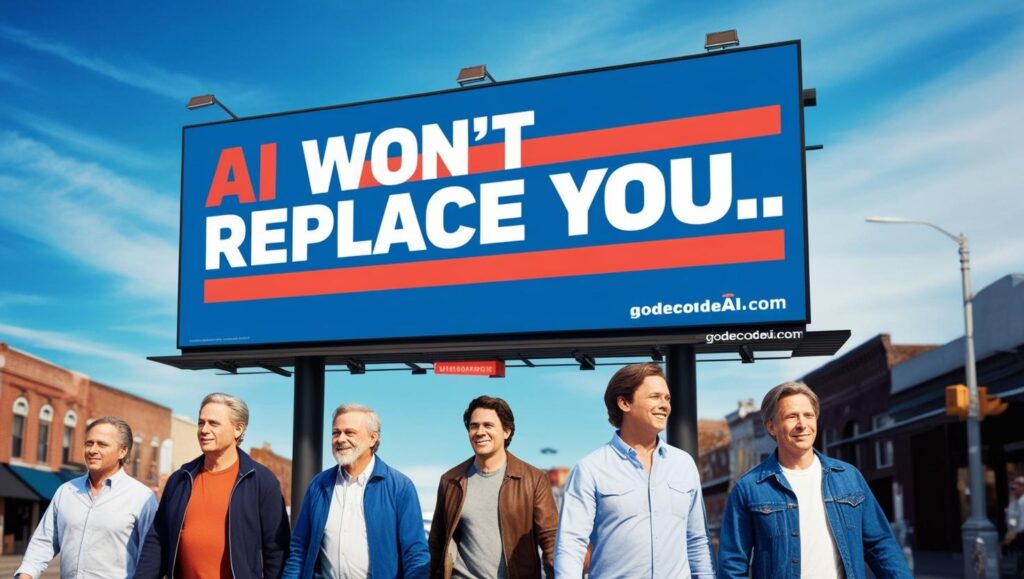
Last updated: July 2026. The line is glib and mostly true: AI won’t take your job, someone using AI might. What’s less discussed is the specific shape of that — which parts of a job actually get absorbed, and which get more valuable. Here’s the honest version, written by someone whose own work has changed because of it.
What actually gets absorbed
Not jobs. Tasks — and specifically the ones with a known shape and a checkable answer. First drafts. Boilerplate. Summarising a long document. Transcribing and writing up a meeting. Producing the fifteenth variation of an ad. Converting a format. Translating.
What these share is that a competent person could verify the output in less time than producing it from scratch. That’s the whole test, and it predicts what’s affected better than any job-title list.
What gets more valuable, not less
- Judgement about what’s worth doing. Producing more of the wrong thing faster is the most common failure we see.
- Being able to tell good from plausible. The output is fluent by default; only expertise separates fluent-and-right from fluent-and-wrong.
- Taste. When everyone can generate competent work, competent stops being a differentiator.
- Accountability. Someone still has to sign their name to it. That person is not the model.
- Everything relational. Trust, negotiation, understanding what a client actually meant.
The uncomfortable part
“Someone using AI might” is usually delivered as encouragement. It isn’t, entirely. If your role is largely the tasks in the first list — junior copywriting, basic transcription, first-draft production — the pressure is real and it’s already arriving. Saying otherwise would be comforting and dishonest.
The second uncomfortable thing: the traditional route to judgement ran through those tasks. You learned to spot bad copy by writing a lot of copy. If the entry-level work is automated, the path to expertise gets narrower, and that’s a genuine problem nobody has solved.
What to actually do about it
- Use the tools on your own work first. Not to publish faster — to find out where they’re wrong. That’s where the useful intuition comes from.
- Move up the stack deliberately. From producing to deciding, from executing to specifying, from writing to editing.
- Keep the verification skill sharp. If you can’t tell when the output is wrong, you can’t use it safely, and that’s the whole job now.
- Don’t compete on volume. That’s the one contest you’re guaranteed to lose.
A worked example from this site
We use AI heavily to produce this directory — compiling product facts, drafting structure, checking consistency across 172 tool pages. What it categorically doesn’t do is decide the verdicts. Every score comes from paying for a tool and using it, and where we haven’t done that we say so on the page rather than generating something plausible.
That division is the point of the whole argument. The machine handles the volume; the judgement — and the accountability for it — stays with a person. See how we test for what that means in practice.
Where to start
If you’re looking for a practical entry point rather than a think-piece: the free tools that genuinely save time, or the freelancer use cases if you work for yourself. For developers specifically, will AI replace programmers covers the same ground for engineering.
FAQs
Which jobs are most exposed?
Roles that are mostly first-draft production with a checkable output. That’s a description of tasks, not of titles — two people with the same job title can be exposed very differently.
Should I put “AI” on my CV?
Only with specifics. “Uses ChatGPT” says nothing. “Cut research time on X by doing Y, and here’s how I verify it” says something.
Is this just hype?
The capability is real and the timelines are consistently oversold. Both things are true, and most bad predictions come from picking one.
Get the best AI tools in your inbox
One useful email a week — tool verdicts, honest picks, and copy-paste prompts. No spam, unsubscribe anytime.