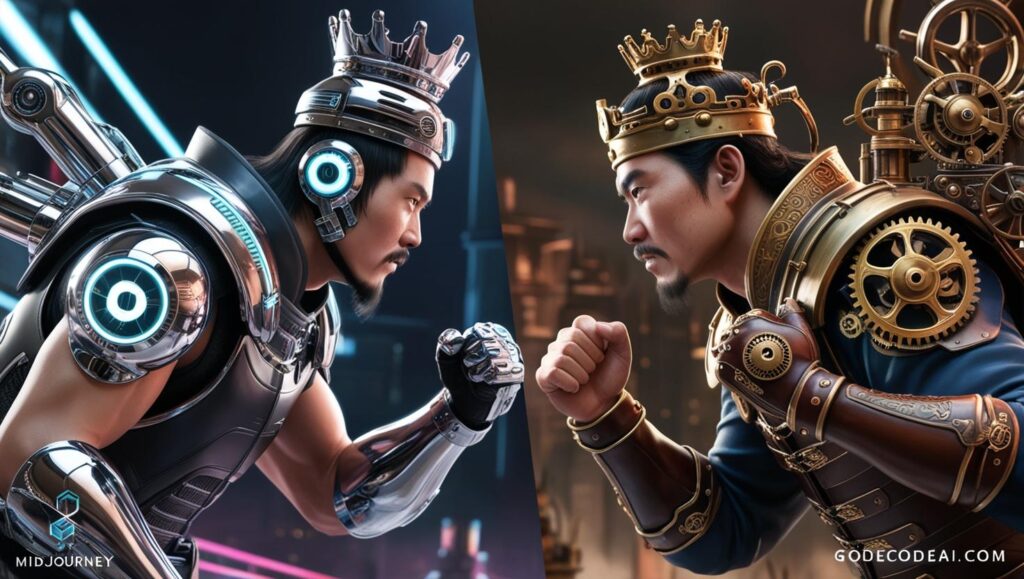
Last updated: July 2026. Midjourney and Stable Diffusion are not really competitors — one is a product with an opinion, the other is a model you run yourself. Choosing between them is a decision about control and effort, not image quality.
A note on scores: both are listings on this site rather than tested reviews, so neither carries a rating. We publish scores only for tools we’ve formally tested and paid for.
Short answer
Midjourney if you want beautiful images with minimal effort and can live with a house aesthetic. Stable Diffusion if you need control, no per-image cost, no content gate, or the ability to train on your own subject — and you’re willing to spend a weekend setting it up.
Midjourney — opinionated, and that’s the point
Midjourney’s output is recognisable because the model has taste baked in. Type something mediocre and you still get something that looks art-directed. That’s the whole value proposition, and it’s also the limitation — the aesthetic is its aesthetic, and steering away from it takes more effort than steering with it.
Style reference and character reference are the features that make it usable for real work rather than one-off images: they keep a look or a subject consistent across a whole set, which is the hard part of production. It’s a paid subscription with no meaningful free tier.
Stable Diffusion — control, at the cost of setup
Open weights mean it runs on your hardware: no per-image cost, no usage limits, no content filter, and nothing leaving your machine. For anyone generating at volume or working with material they’d rather not upload, that’s decisive on its own.
The real advantage is control. ControlNet lets you dictate pose, depth and composition rather than hoping the prompt lands. LoRAs and fine-tunes let you train it on a specific subject, product or style. There’s a large ecosystem of both.
The cost is your time. You’ll pick a checkpoint, install an interface, learn what the settings do, and troubleshoot. If that sounds like a bad evening rather than a good one, Midjourney is the honest recommendation.
The third option most comparisons skip
If your images need legible text — posters, packaging, social graphics with words — neither of these is the right tool. Ideogram is built specifically for that and it’s the one to use. If licensing provenance matters for commercial work, Adobe Firefly is trained on licensed content and sold with enterprise indemnification. And if you need editable vectors rather than a bitmap, Recraft outputs real SVG. All three are listings here rather than tested reviews.
Which should you choose?
- Best-looking images, least effort: Midjourney.
- Control, volume, privacy, no per-image cost: Stable Diffusion.
- Readable text in the image: Ideogram.
- Commercially defensible licensing: Adobe Firefly.
- Editable vectors: Recraft.
FAQs
Which produces better images?
Midjourney, out of the box, for most prompts. A well-configured Stable Diffusion setup with the right checkpoint and ControlNet can beat it for a specific job — but “well-configured” is doing a lot of work in that sentence.
Is Stable Diffusion free?
The weights are, and running it locally costs nothing per image. You need a capable GPU, and your time is the real price.
Can I use the output commercially?
Depends on the tool, the plan and — for Stable Diffusion — the specific model licence, which varies between checkpoints. Check before you ship anything commercial. This is the detail people skip and then regret.
Get the best AI tools in your inbox
One useful email a week — tool verdicts, honest picks, and copy-paste prompts. No spam, unsubscribe anytime.